
Creating a Data Source for Recommendations
The data source is a recommendation filtering algorithm that can be applied to the website, media channels, and mobile application.
Creating a data source is mandatory when setting up any recommendation type in eSputnik.
Note
- When setting up website recommendations in the eSputnik admin panel, you can select the data source directly when configuring recommendations.
- If your site restricts access by IP, for example, by using a firewall or staging environment, allowlist eSputnik's site-crawl IPs so the system can read your pages:
18.193.171.62,3.66.101.249, and52.16.166.210.
Automatic Data Source Creation for Triggers
When the Professional plan is activated for an organization with web tracking enabled, eSputnik automatically creates the predefined data sources required for recommendation triggers.
The data sources are created only once. If some of them already exist, eSputnik creates only the missing ones. A data source that was created automatically and then deleted is not recreated.
If a product feed has not been uploaded yet, the data sources are created with predefined required fields, such as product ID, name, and price. You can still create data sources manually for custom or other recommendation algorithms.
Creating a Data Source in Account Settings
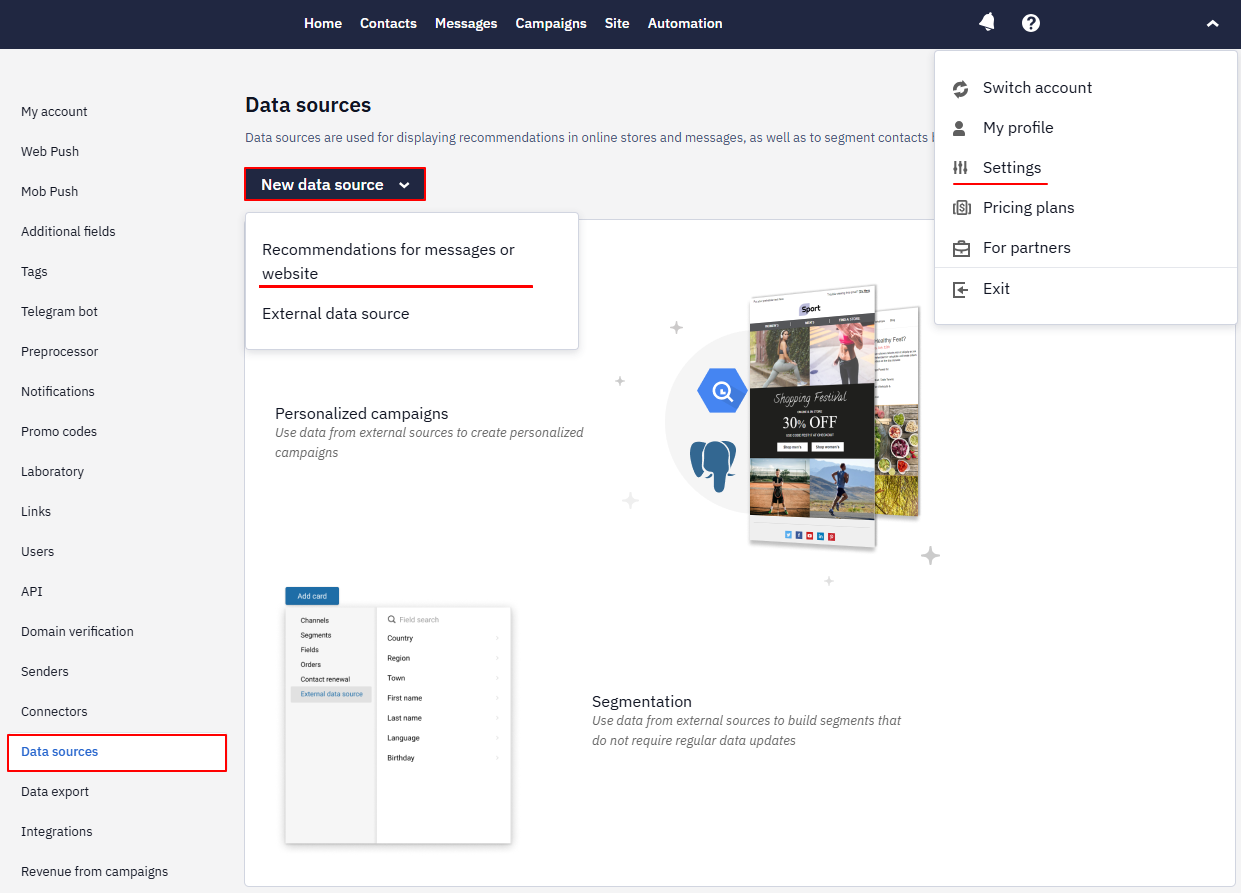
- Go to account settings:
- In the menu on the left, select the section Data sources and click New data source → Recommendations for messages or website:
- Select a recommendation algorithm.
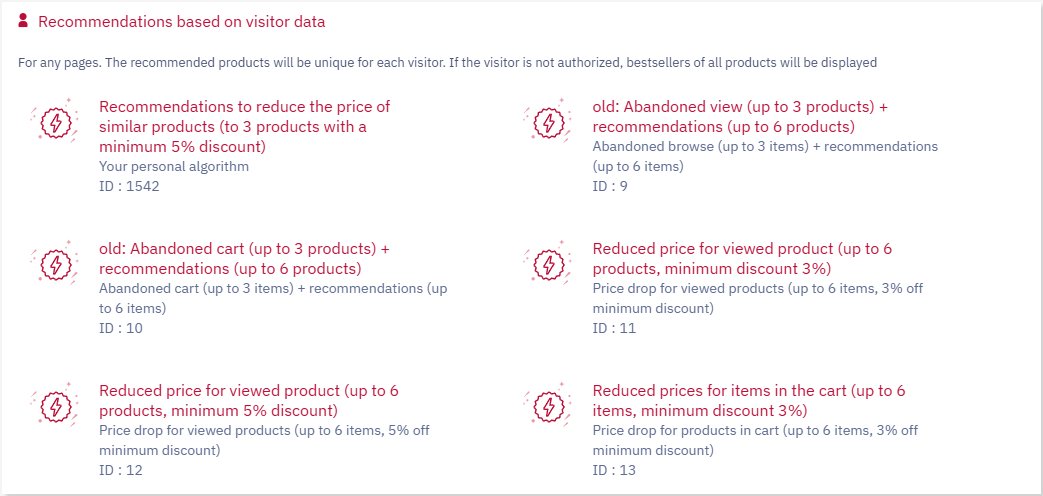
- Recommendations based on visitor data. The recommended products will be unique for each visitor. If the visitor is not authorized, bestsellers of all products will be displayed.
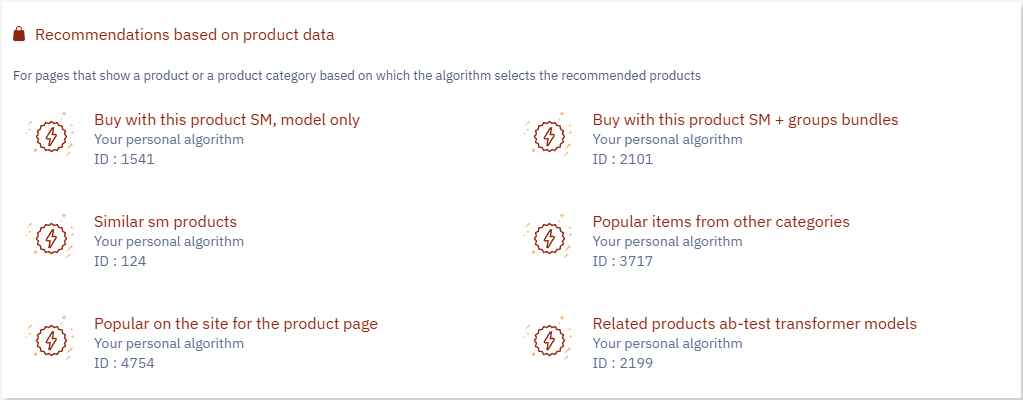
- Recommendations based on product data. for pages that show a product or a product category.
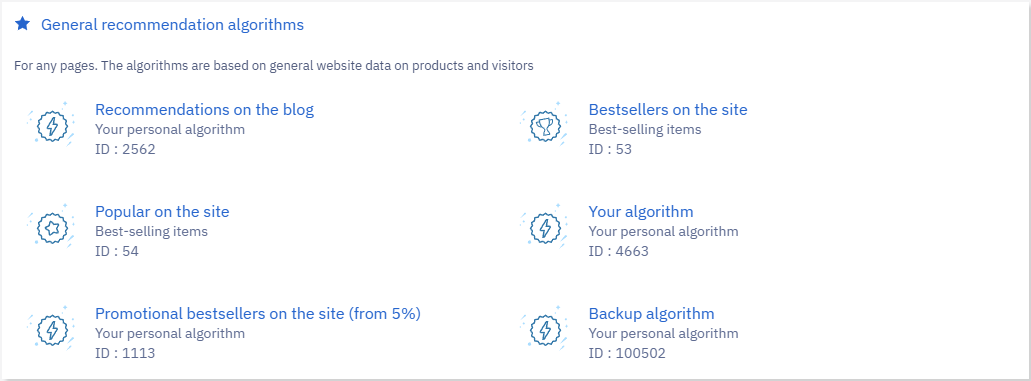
- General recommendation algorithms.
In addition, you can add custom filtering rules for the block.
NoteFor email recommendations, use the following data sources:
- Abandoned cart (up to 6 products);
- Recommendations for 6 abandoned products in the cart (up to 6 rec.);
- Abandoned view (up to 6 products);
- Recommendations for 6 abandoned views (up to 6 rec.);
- Personal recommendations or bestsellers (up to 6 rec.) — for promo campaigns.
To find out which source is better to use for other triggered campaign types, please contact our support team at [email protected]
- Specify a unique source name.
Important
- The name may contain only Latin letters (A–Z, a–z), digits (0–9), and the underscore
_.- The name cannot start with a digit.
- The use of spaces, Cyrillic letters, or special characters is not allowed.
Examples:
name_source,User123,DATA_2025.The name can't be changed after the source is created, and messages and workflows address the source by it, so choose it now. A name entered in another alphabet is converted at creation:
Abandoned cart (up to 3 products)becomesabandoned_cart_up_to_3_products.
- Configure the available data source settings, and click Save.
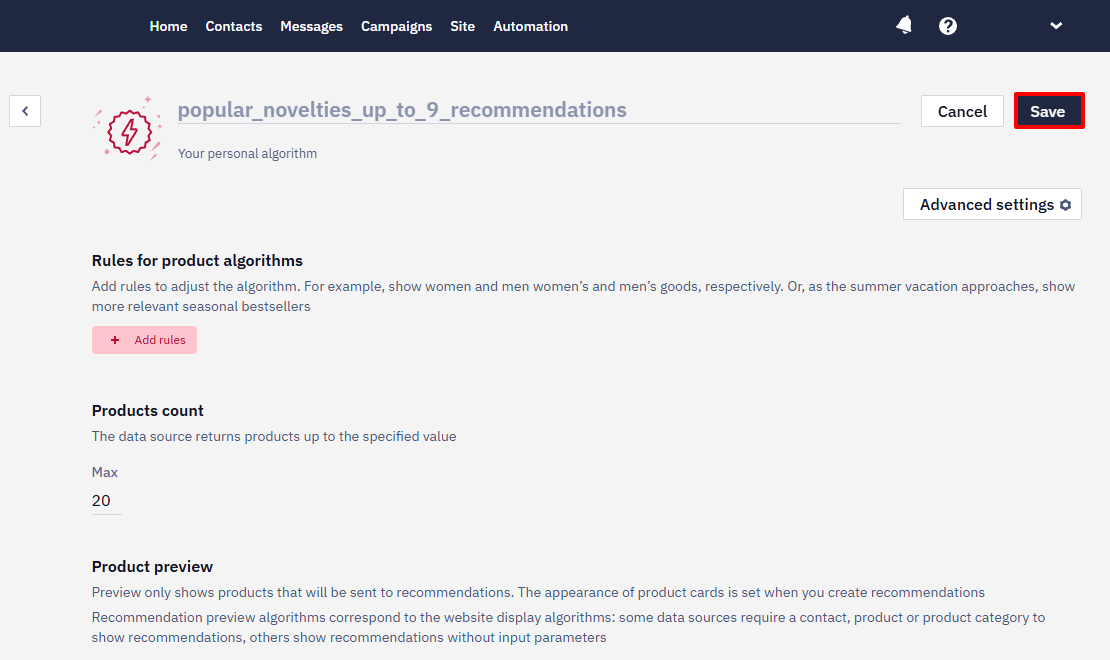
The data source settings page contains the following settings for all recommendation types:
- Rules for product algorithms: custom rules that adjust the algorithm output.
- Products count: the maximum number of products the data source can return. In the Max field, enter the upper limit for products in the recommendation result.
- Product preview shows only products that the system will send to recommendations. You set the appearance of product cards when you create recommendations.
Recommendation preview algorithms correspond to the website display algorithms: some data sources require a contact, product, or product category to show recommendations, while others show recommendations without input parameters.
On a page where no product is passed — an empty cart, for example — a source that requires a product shows nothing. To keep the block filled in that case, use a source from Recommendations based on visitor data, which falls back to bestsellers when there is no data on the visitor, or from General recommendation algorithms.
Advanced Settings
For Recommendations based on visitor data, you can configure advanced settings for using data sources in messages. To open them, click Advanced settings on the data source settings page.
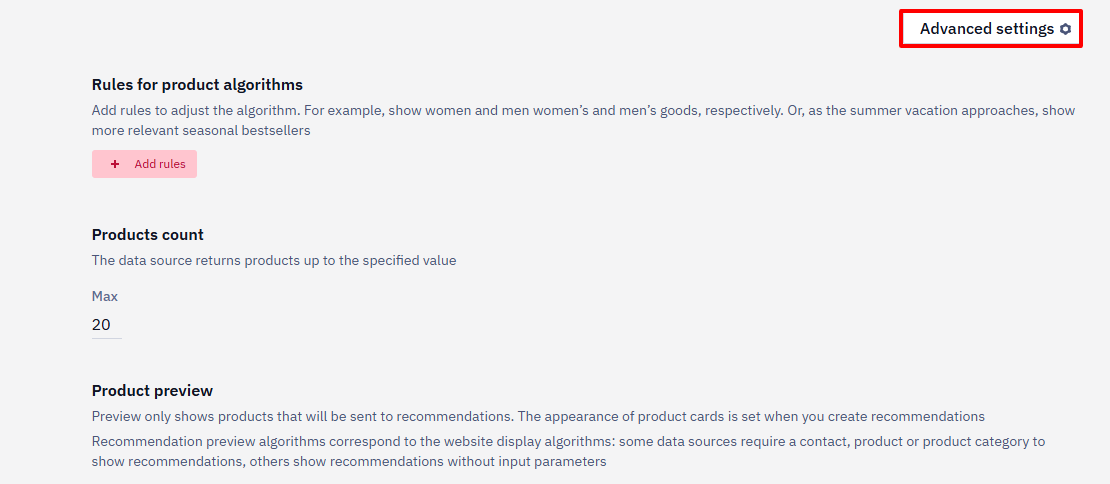
Advanced settings include:
- Filters: conditions for selecting products.
- Product exclusion conditions: conditions for excluding products from recommendations.
- Field transformers: rules for modifying product field values, for example, converting prices to the accepted format.
- Regular expressions: expressions for converting product field values to the accepted format.
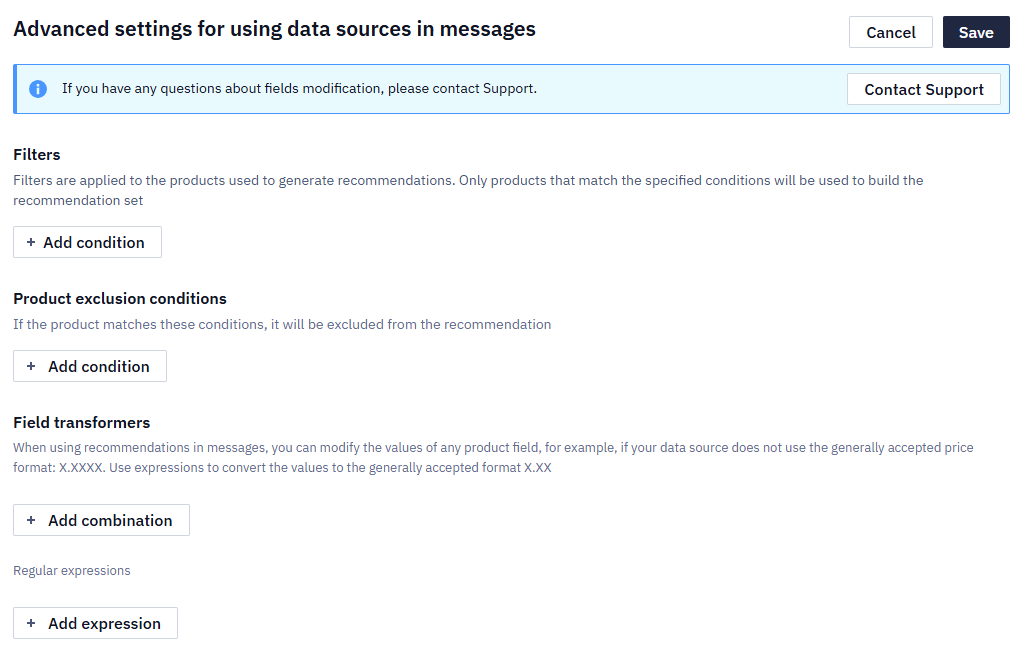
Filters work differently depending on how the data source selects products:
- If the data source can generate recommendations, you can select rules for it or use rules that you have already selected. In this case, the system applies filters to the products it uses to generate recommendations and uses only matching products to build the recommendation set.
- If the data source returns products from the user's previous actions, such as cart or viewed products, you cannot select rules for it. In this case, the system applies filters to the products the user has interacted with, and the result includes only matching products.
The created data source will appear in the general list.
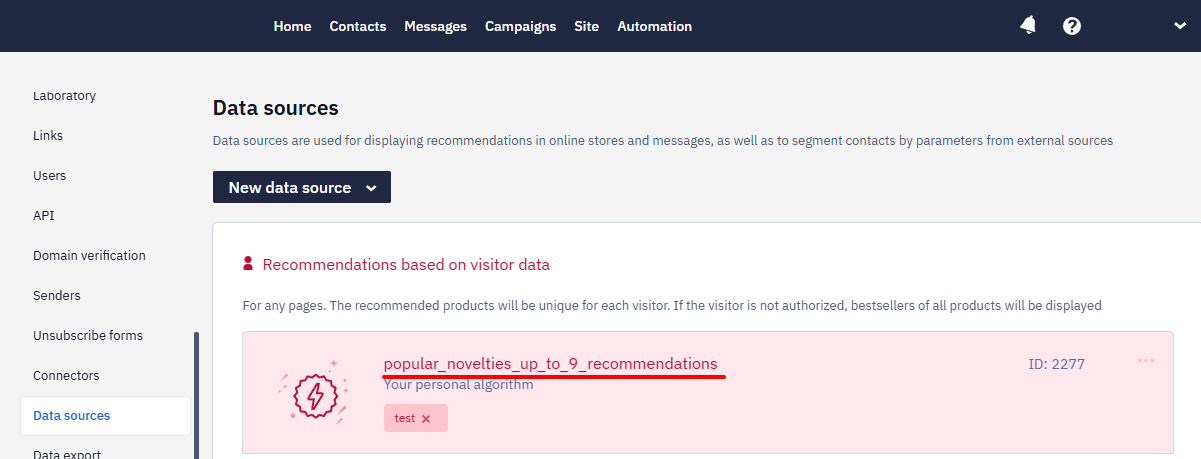
You can use the generated source when setting up recommendations for your site, app, and campaigns.
Copying a Data Source
To set up a similar source without repeating the whole configuration, copy an existing one. In Data sources, open the menu on the source card and select Copy.
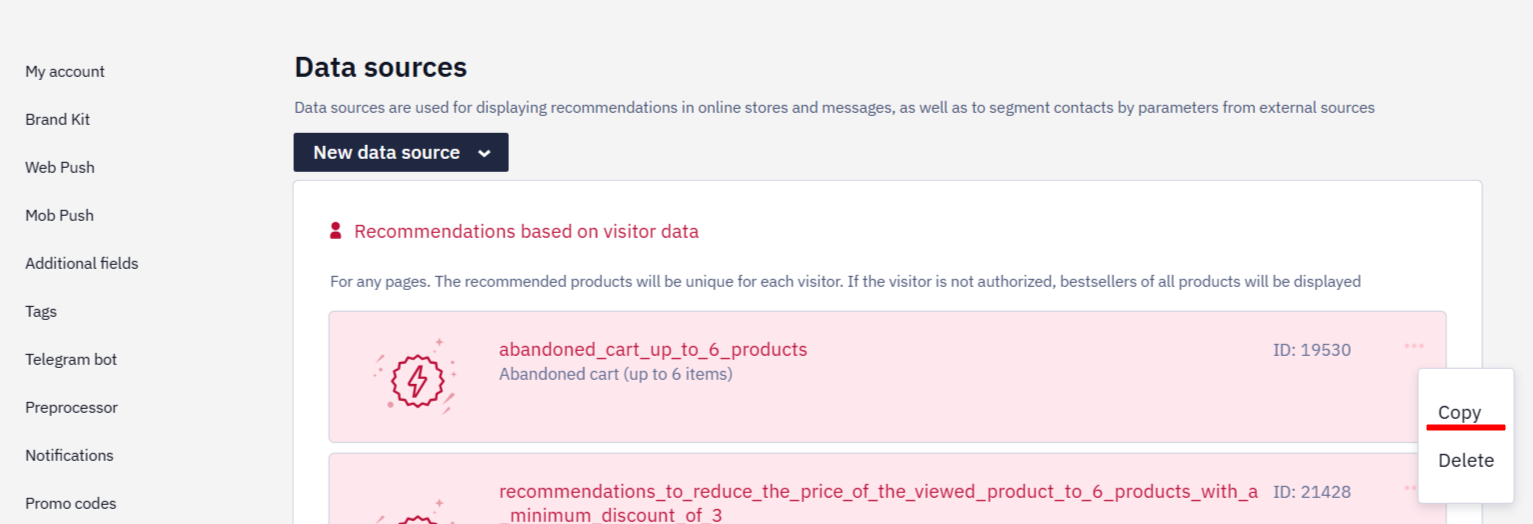
The copy keeps the algorithm, the settings and the rules of the source it was made from. Check them, give the copy a name of its own and save it as a separate source. The naming rules apply to the copy as well, and a name that another source already uses is rejected.
Updated 1 day ago